


To borrow a phrase from novelist Thomas Wolfe, you can’t go home again. Not that I didn’t try. After some sixteen months of being cooped up in a 2-bedroom rental house in Calgary, Canada, I was itching for a road-trip. And my childhood home, a farm three miles west and one mile north of the village of Yellow Creek, Saskatchewan was calling my name.
True, my residence in Calgary is my current home. But, despite living in many different buildings, in different provinces and in different countries, this quarter section of land is forever etched in my mind as home.
It all starts with a telephone conversation with my oldest brother, George. He, like many others, was using his down-time during a global pandemic sorting through some of our mother’s things and was becoming quite nostalgic.
“This has been on my bucket list for some time. I want to visit our farm in Yellow Creek.”
“I have an idea. Why don’t I come down to Edmonton and we can drive there together? I would appreciate company on that long drive. Anyway, it will be an excellent way to reminisce and catch up on what’s happening in our lives.”
I tell my son about our plan.
“I want to go, too! Haven’t been to that place since I was a kid, and I wouldn’t know how to find it by myself.”
I considered giving him the following directions: “Go 3 miles west of Yellow Creek on the 44 Trail, past Gryba’s elevator. When you get to the Catholic cemetery, make a right turn onto the gravel road past Semeniuk’s place. Watch for Dull’s house on your left. It’s directly across the road from the Papishes. Go around Papish’s slough. When you see the alfalfa field on your left, you’re nearly there. Look for the poplar bluff. When you get to the bottom of the hill, you will see the driveway to the yard. The house will be at the top of the hill. If you reach the road to Crystal Springs, you’ve gone too far.”
But sadly, I know many of those landmarks are now gone. So, arrangements are made for when everyone is able visit the farm together. The date is set, the beer is bought, the gas tank full, and George and I start our road-trip to Saskatoon where we will be staying at my other brother’s place. Of course, we stop at Stawnichy’s store along the way. This business in Mundare, Alberta makes the best garlic sausage in the world, bar none. And there’s nothing that makes prairie folk of Ukrainian descent happier than a ring of garlic sausage.
George has many more memories on the Alberta side than I do and regales me with shenanigans of his baseball playing days as we pass ballparks, or where ballparks used to be along the way.
I don’t know if it’s his age, a small bladder, a regression into his childhood or a trigger to ball-playing days, but soon he needs to make a pit stop. And we’re on the highway in the middle of Nowhere, Saskatchewan. We’re scanning both sides of the highway, looking for a suitable place to pull over and stop the car. Presently, the perfect location presents itself. It’s a turn-off from the highway, sheltered on both sides of the road by dense brush. Unlike me, George is near-sighted and doesn’t immediately see that crudely hand-written sign in front of us.
“Quick, turn the car around! We need to get out of here!”
“What? What? It’s the perfect spot.”
“No, it’s not! Can’t you see that sign?”
Against my better judgement, he pulls the car up closer to the sign to read it. The sign reads, “This is not a piss stop so stay the f***off this property.”
Well, now he takes it seriously. He’s not keen on getting a butt full of buckshot from an angry landowner. We drive on.
A few days later, my son and family arrive in Saskatoon, and we set off to the village of Yellow Creek. Well, it’s no longer a village but a hamlet. So many buildings are gone. As we drive down the main street, called Railway Avenue, we are struck by the irony of the name. The railway tracks have long since been removed. As has the train station itself, the grain elevators, the grocery stores, the pool hall, the hardware stores and both cafés. Gone. All gone. George points to an empty lot.
“The movie theatre was right over there,” he says. “I remember going to many movies there,” he adds nostalgically.
“Yes, the billboard advertising upcoming movies was here, across the street,” I comment. “And the John Deere dealership was on this corner.”
“That’s right! And a friend of mine lived in one of those houses just up the hill. Wasn’t there a service station somewhere, too?”
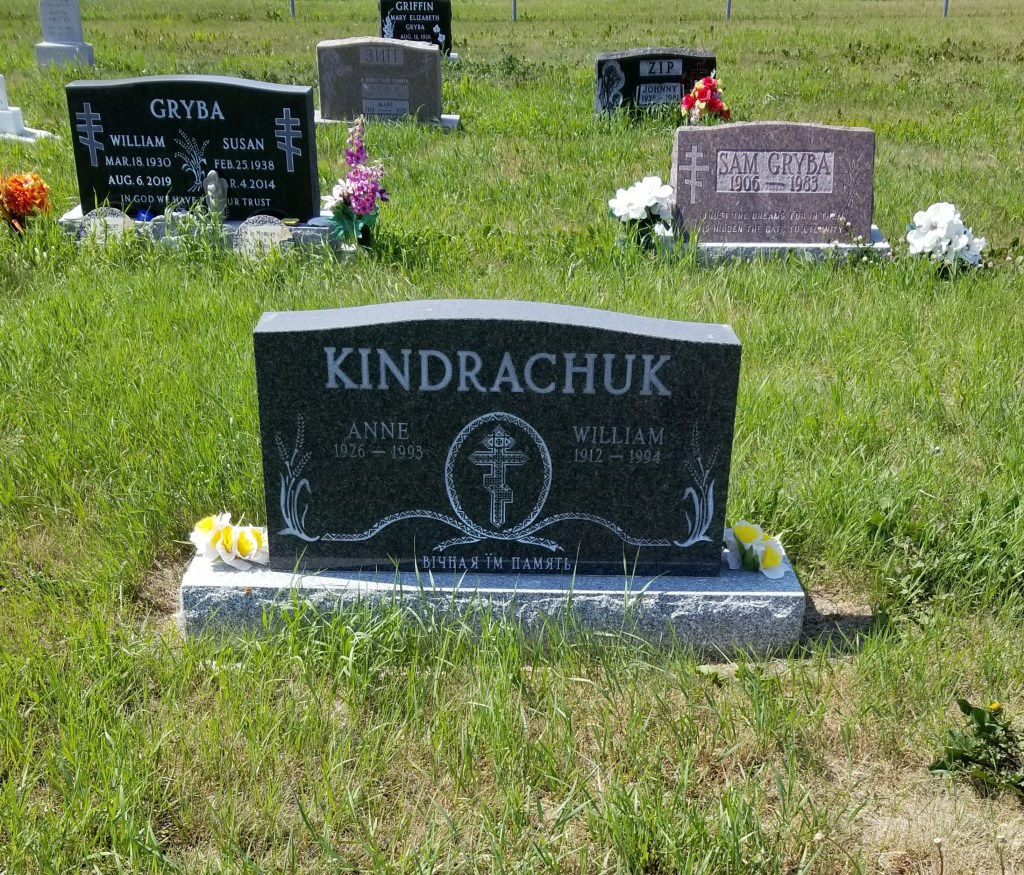
“There were actually two that I recall. One was near here where Bill had his Cockshutt dealership. Darlene lives in Bill and Anne’s place now. Let’s knock on her door and say hello.”
Across from Darlene’s is another empty lot where the Catholic church once stood. A dog runs around in circles in the enclosure, barking at us. He’s probably just excited to see visitors. Darlene’s not home so we continue the tour. The Orthodox church is still standing, and just as we’re discussing whether it’s still in service, a woman on a riding lawnmower circles in front of the church. It’s Darlene!
“We went to your house and knocked on your door,” I say, “but you didn’t answer.”
She laughs. My son and family, who have been following George and me, get out of their vehicle now and we all catch up on the local gossip.
“Are you going to the street dance tonight?” Darlene asks. “Live band. Only $20.”
“Ah, that’s what was going on in front the hotel,” says my son. “We saw them setting up.”
So, there appears to be some activity here after all. But now everyone is getting hungry. Time to find a place for a picnic. I suggest the schoolyard.
We circle my old school which has been repurposed as, among other things, a coffee shop and a fire hall. We clamour out of our vehicles in front of Rosie’s Coffee Shoppe. In front of us is what appears to be a post office and a newspaper stand. George grabs a copy of the local paper, but there’s no coffee for us. Rose is closed for the day; she only serves coffee in the mornings. Just as my grandson scans a cairn in front of the school looking for our family name, a wicked gust of wind blows dust in our faces. It’s been very hot and dry here this summer. We seek shelter at the opposite end of the school, but this location is not much better. Now we, like the Berenstain bears, are searching for the perfect picnic spot.
Hmm. Let’s try behind the old community hall. At any rate, the children and some of the adults need to use the toilet at this point and there are plenty of bushes there. Let’s hope there aren’t any angry farmers with no trespassing signs. Nope, no signs. We’re good.
This potential picnic spot is not much better than the school grounds. It’s still windy here. Besides, it’s just too close to the outdoor biffy.
“Why don’t we go to the churchyard?” suggests my clever daughter-in-law.
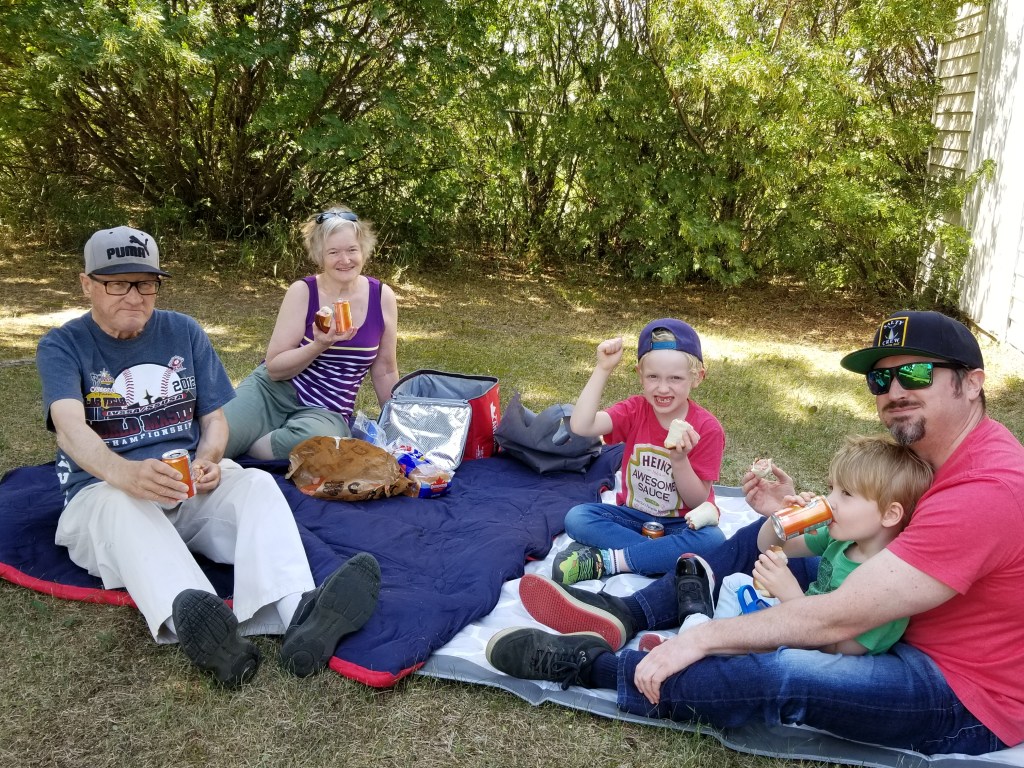
The churchyard it is. Freshly mown grass and sheltered by a caragana hedge. The perfect picnic spot. My brother and I are reliving a fond childhood memory. Whenever we would go to the big cities of Prince Albert or Melfort for shopping, dental appointments, or a country fair, our father would stop into a grocery store to buy sliced white bread, a ring of garlic sausage and some Orange Crush pop. Then we would pull over on some country road, break off a piece of sausage, roll it up in the bread and wash it all down with the pop. This is the picnic lunch that is duplicated in the Yellow Creek churchyard.
“What do you think of baba’s lunch?” I ask my grandchildren.
“It’s AWESOME!” says the 3-year-old.
He’s not so enthusiastic when we finally reach the old homestead. The house is not visible from the grid road; it’s somewhere there in the bushes. George runs on ahead, searching for the path.
“These monstrous caragana bushes are brutal,” says my brother. “There’s no way we’ll get through to the house! I’m going to try to access it from the other side.”
Actually, this is not a direct quote. His language is much more colourful than that, but there might be children reading this.
I, on the other hand, search for a gap in the caraganas and soon discover one that should be in line with the location of the house. I part the bush to allow my 6-year-old grandson to go ahead of me. He’s all wide-eyed and looking forward to this adventure. Not so much the younger one.
“I don’t want to go on an adventure,” he wails.
But if his big brother is willing to tackle this jungle, so will he. The rest of the family, except for George, follow. The older grandson and I spot the house at the same time.
“George. GEORGE. Over here!” we all call out.
No answer.
“GEORGE. We found the house!”
Several minutes later my brother, arm bleeding from fighting overgrown brush, surfaces around the back of the house.
“Where were you?” we ask.
“I tried to find the other path to the house. The one where you don’t need to go through those caragana trees.”
“One time. Just once you should listen to your baby sister,” I admonish him. “I found it right away.”
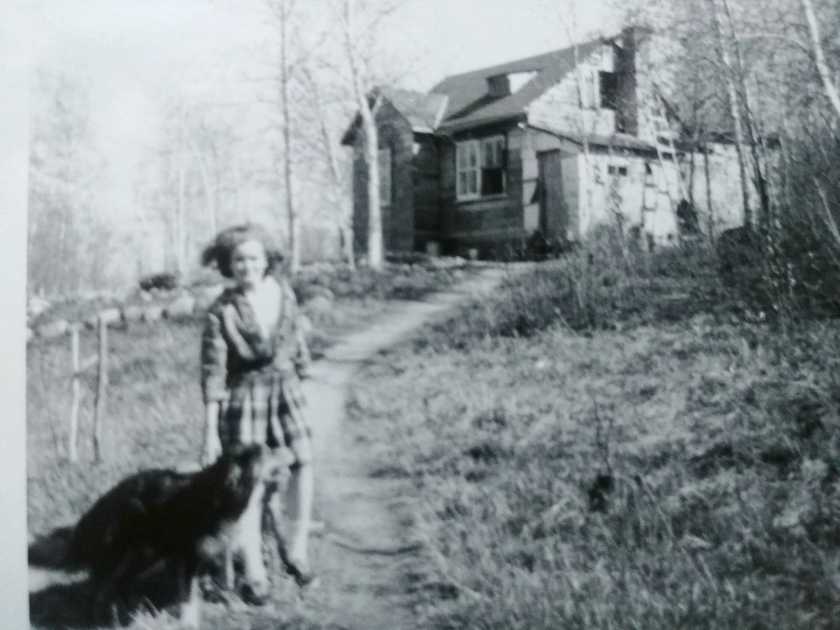
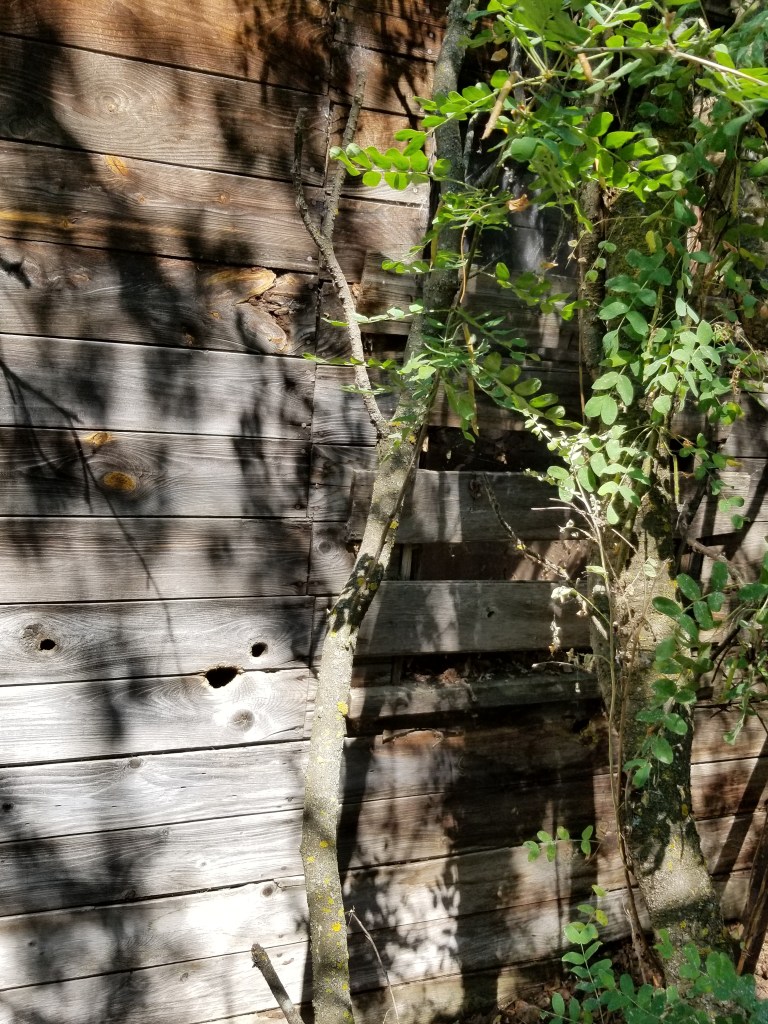
All of us then proceed to explore what’s left of the house. The most recent addition to the house has collapsed but the kitchen windows are all still intact. And the interior paint job still a vibrant blue. Not bad for a building erected over 65 years ago and uninhabited for the past 50. Except perhaps for the wild animals who found this treasure in which to shelter from the elements.
Meanwhile, the 6-year-old is on another type of treasure hunt.
“Look what I found! A hockey stick.”
“With tape still on the blade!” adds my son.
We wind up our trip down memory lane by driving north to the end of the grid road and turning left to the village of Crystal Springs. More farmland devoid of buildings and trees greets us along the way. Except, that is, for our next-door neighbour’s land to the north of us. When that couple retired and moved into town, they sold the land to the government to be used as a game preserve. Their log cabin is still somewhere there in the bush, no doubt, but would be even harder to find than our own house.
We make the loop back onto the 44 Trail towards Yellow Creek with me complaining all the way.
“We really should have taken your SUV to drive on these country roads,” I say to my brother George.
“What’s the problem? You’re a country girl. You should be used to this.”
“A country girl without a car. So, no. I’m not used to driving on grid roads.”
“What the hell is a grid road, anyway?”
“Gravel.”
“Why don’t you just say ‘gravel’?”
The paved highway back to Saskatoon leaves plenty of time for reflection. For my son, the trip was one of nostalgia, remembering when he last visited here as a child and imagining his mother growing up on this land. For me, who had visited here a mere three years ago, it was also nostalgic, and I enjoyed the wide-open prairie views. But my brother George, on the other hand, found the whole trip rather depressing. It’s been over 20 years when he last visited, and he just wanted things to be the same as they were.
They say you can’t go back home again, but like it reads on the cairn in the old schoolyard, “Friendship and fond memories will always remain”.





 Irene Pylypec